FORMAT CHECK · ORIGINAL TEST
MP3 to MIDI: Does WAV give better results? A same-melody test
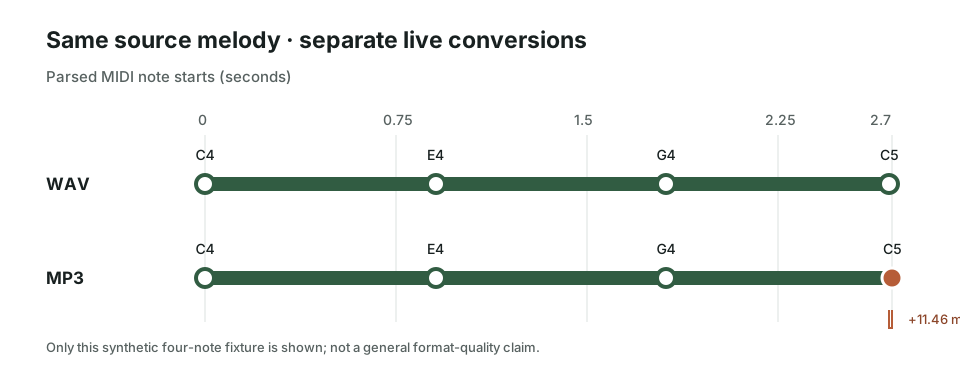
In this one controlled test, WAV and MP3 produced the same four pitches, but the last MP3-derived note began 11.46 milliseconds later. That small difference is an observation from one synthetic melody converted with this site—not proof that WAV always converts better or that either format will match a real performance.
If you already have the original WAV, try it before transcoding it to MP3. If you only have an MP3, this test gives no reason to reject it: both files produced the same four-note sequence here. Compare the MIDI events against your own recording instead of treating a file extension as an accuracy guarantee.
The controlled comparison
We made one four-second, mono, 44.1 kHz, 16-bit PCM WAV containing four synthesized pitches: C4, E4, G4, and C5. The tones were generated in sequence from one repeating recipe. We encoded that exact WAV waveform as an MP3, then submitted the WAV and MP3 separately to the live MP3-to-MIDI converter on this site. Each run returned a downloadable standard MIDI file marked “4 notes · 4.0 seconds.”
The input files differ in size: the WAV is 352,844 bytes and the MP3 is 32,617 bytes. They are not two independently performed takes: the MP3 is a lossy encoding made from the WAV. The SHA-256 hashes are recorded in the downloadable test manifest so the inputs can be identified exactly.
| Event | WAV input | MP3 input | MP3 minus WAV |
|---|---|---|---|
| C4 · MIDI 60 | 0.000000 s | 0.000000 s | 0.000000 s |
| E4 · MIDI 64 | 0.905208 s | 0.905208 s | 0.000000 s |
| G4 · MIDI 67 | 1.811458 s | 1.811458 s | 0.000000 s |
| C5 · MIDI 72 | 2.683333 s | 2.694792 s | +0.011458 s |
Both exports contained four notes and lasted 4.0 seconds. Among the four event start times, only the fourth differed: 0.011458 seconds later for the MP3-derived MIDI. The MIDI files were not otherwise identical: the parsed C4 and G4 velocity values differed, and the final C5 duration was 0.801042 seconds for WAV versus 0.789583 seconds for MP3. The table compares starts only; the linked JSON contains the parsed durations and velocities too.
Reproduce or inspect this exact test: source WAV · MP3 encoded from that WAV · WAV-run MIDI · MP3-run MIDI · parsed note events and input hashes.
What this test can—and cannot—tell you
This test supports a narrow statement: these two files, submitted separately to the current live converter, yielded the listed notes and event times. It does not establish an average accuracy difference, identify a cause for the last-note offset, or predict how a piano recording, chord, full song, or another MP3 encoder will behave.
WAV is uncompressed, while MP3 is lossy; the audio detail removed during MP3 encoding is not restored by changing the MP3 container into WAV. A WAV copy made from an MP3 is still based on that MP3. If you have the original lossless source, use it for a fair comparison. If you have only an MP3, converting that same file to WAV cannot recreate information that was discarded.
For your own check, convert the original file you actually plan to use, then import its MIDI into a DAW and compare the note starts with the audio. This site returns detected notes on one instrument track; it does not separate instruments or guarantee a perfect transcription.
Does WAV always make a better MP3-to-MIDI conversion?
No conclusion about “always” follows from one four-note synthetic fixture. Here the pitches and first three event starts matched, while the fourth event began about 11.46 milliseconds later in the MP3 run. Test your own original recording if the timing difference matters to your project.
Should I convert my MP3 to WAV before using an MP3-to-MIDI tool?
Not to restore quality: transcoding an MP3 to WAV cannot recover audio detail already removed by MP3 encoding. If you possess the original WAV, use that original rather than a WAV made from an MP3. This site accepts either MP3 or WAV for conversion.
Can I inspect the MIDI instead of trusting a score?
Yes. Download the MIDI and open it in a DAW or MIDI editor to inspect note pitches and event positions. The linked JSON reports the parsed events from this exact test; it is evidence for these two runs, not a prediction for your file.