CHORD CHECK · HISTORICAL TEST RECORD
MP3 to MIDI adds extra notes? Check chord pitches before deleting
Extra MIDI notes are possible even in a short, clean chord recording. The retained historical record describes six planned pitch events and nine detected events. The original files are unavailable, and these counts have not been revalidated for the current converter. Compare each detected pitch with the intended chord before removing anything: a simultaneous note is not automatically an error.
What the historical two-chord record describes
We generated a four-second mono recording rather than using a copyrighted song. The first chord contained MIDI pitches 60, 64, and 67, starting together at 0.25 seconds and ending at 1.50 seconds. The second contained pitches 65, 69, and 72, starting together at 2.00 seconds and ending at 3.25 seconds. These are C major and F major in this register. The plan therefore contains six intended note events, not six sequential melody notes.
Each pitch was synthesized as a sum of four harmonics with a short onset envelope and a decay. We saved a 44.1 kHz, 16-bit PCM WAV, then encoded an MP3 from that exact source using libmp3lame. The generator script and the planned note list are linked below. This is an artificial harmonic signal, not a piano performance.
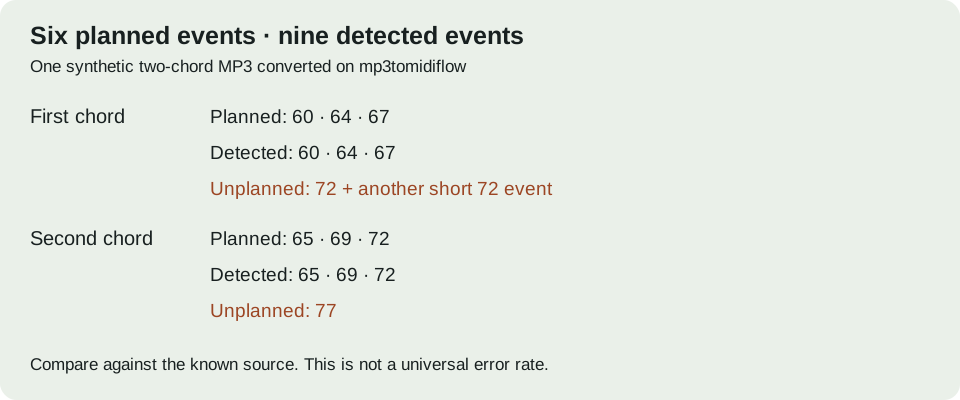
The retained record reports processing the MP3 with the then-live browser converter and saving its MIDI. The result panel reported nine notes and four seconds. Parsing the downloaded file found the first chord's intended pitches 60, 64, and 67 near 0.255208 seconds. It also found pitch 72 there, although that pitch was not planned in the first chord, and another short pitch-72 event at 1.172917 seconds.
| Segment | Planned pitches | Detected pitches |
|---|---|---|
| First chord and tail | 60, 64, 67 | 60, 64, 67, 72; another 72 at 1.172917 s |
| Second chord | 65, 69, 72 | 65, 69, 72, 77 |
The second chord's intended pitches also appeared: 65 and 69 started at 1.986458 seconds, and 72 at 1.997917 seconds. Pitch 77 appeared at 2.009375 seconds although it was not in the second chord's plan. Thus all six planned pitch events were represented, alongside three unplanned events. We checked pitches and event positions against the generator, not against a subjective listening score.
For a source-format cross-check, the WAV run returned eight events. It included the same unplanned pitch 72 during the first chord and pitch 77 during the second, but not the additional short pitch-72 event seen in the MP3 tail. Neither export was a perfect six-event reconstruction. This observation does not identify the cause of the extras or establish an accuracy rate for other recordings.
Surviving historical records and unavailable samples: generator · planned events · source MP3 (chords.mp3) — unavailable · source WAV (chords.wav) — unavailable · MP3-run MIDI (chords-mp3-result.mid) — unavailable · WAV-run MIDI (chords-wav-result.mid) — unavailable · recorded events and input hashes.
How to check your own chord transcription
Keep the original audio beside the MIDI in your editor. Inspect one chord at a time. Compare pitch names, the onset region, and how long each event lasts. If you know the intended notes, use that reference rather than assuming the converter's count is correct. If you do not know them, listen and investigate before deleting a note merely because it overlaps another.
This site produces detected notes on one instrument track. A chord may contain several overlapping notes on that same track. That is not instrument separation, and it does not identify which player or sound produced each event.
Are all extra notes octave errors?
No. Our unplanned pitches included octave relationships to lower planned pitches, but this test cannot establish why they appeared. Do not classify every extra note in your own result as a harmonic or octave error without checking the recording.
Should I delete every short MIDI note?
No. Duration alone does not tell you whether a note was intended. The short pitch-72 event was unplanned here because we had the exact generator plan. In real music a short event could be a deliberate note.
Does this prove MP3 always detects more notes than WAV?
No. These retained counts describe one historical generated pair and two reported conversions; the original files are unavailable for independent reproduction. They are not an average, a ranking of formats, or a prediction for your file. The useful takeaway is to audit the chord events, not to trust a larger note count.